
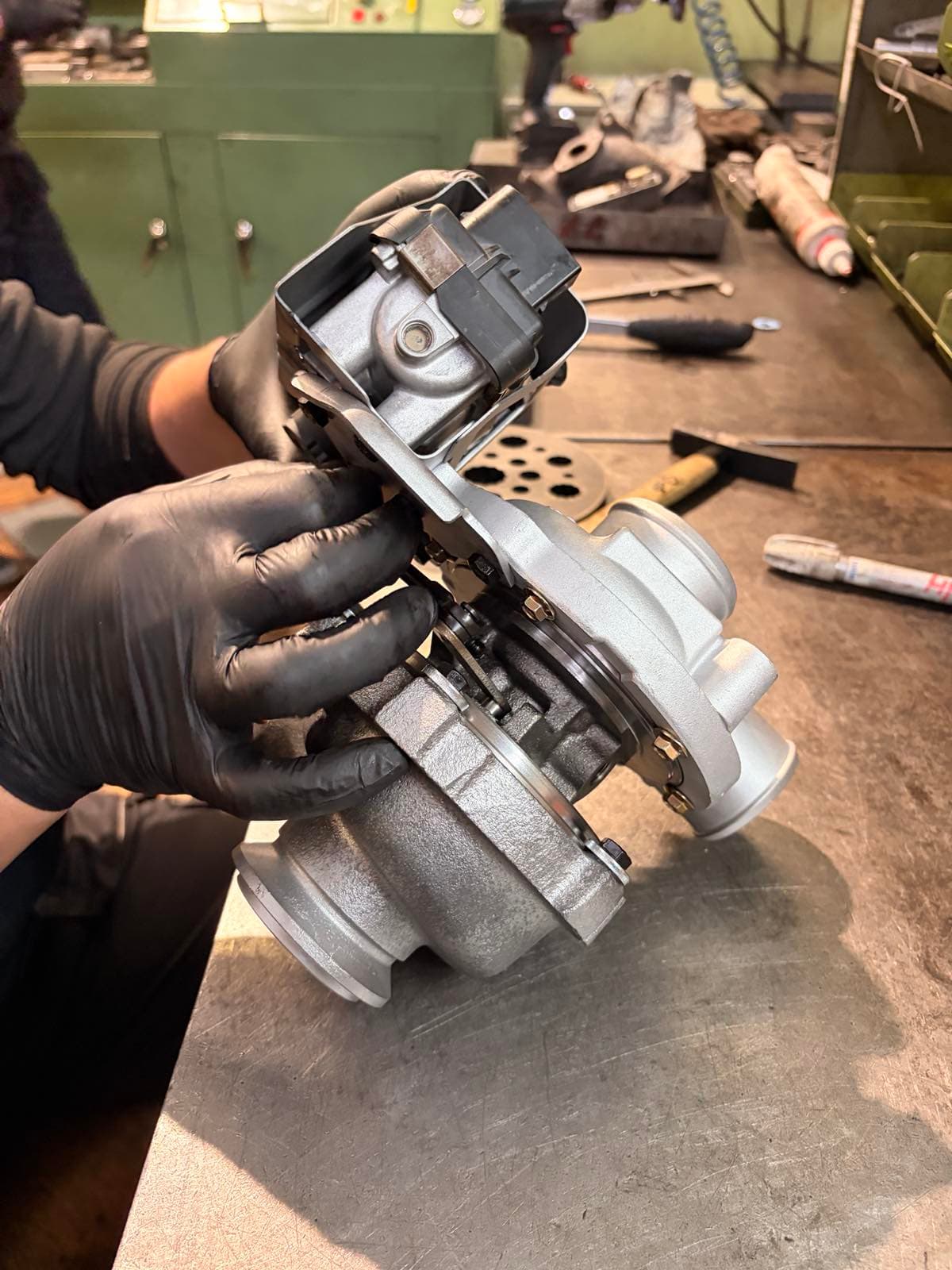
Reconditioning involves a complete strip-down, cleaning, replacement of worn and damaged components and precise adjustment of the turbocharger. This restores its condition and performance at a significantly lower price than a new turbocharger.
As well as fixing the failure, we also look for its cause. This allows us to advise the customer on any additional vehicle checks needed to avoid a repeat problem.
Warranty
Turbocharger repairs carry a 6-month warranty.
How does reconditioning work?
- 1
Turbocharger strip-down
The turbocharger is stripped down into its main assemblies: core assembly (CHRA), housings, variable geometry mechanism and actuator – depending on the design of the model.
- 2
Core assembly (CHRA) inspection
The core assembly is fully dismantled. We inspect and measure the components to assess their condition and look for the cause of the failure. We share our findings with the customer and recommend any follow-up checks.
- 3
Cleaning and inspection of the other components
We clean the housings and the variable geometry mechanism, if fitted, and check them for cracks, distortion and other defects. On models with an actuator, we check its operation, whether it is vacuum or electronic. All worn and damaged parts are marked for replacement.
- 4
Quote preparation and approval
We determine the most suitable repair option and agree it with the customer before any repair work begins.
- 5
Housing machining
Where necessary, we machine the threads and mating surfaces of the housings.
- 6
Core assembly replacement or reconditioning
Depending on the model and the available components, we use one of the following two approaches:
A) Replacement with a new core assembly
As standard, we recondition with a brand-new core assembly whenever one is available for the model. We test it on a Turbo Technics VSR high-speed balancing machine for imbalance and oil leaks at speeds of up to 250,000 rpm, depending on the model.
B) Core assembly reconditioning with individual components
This approach is most often used for large turbochargers on less common transport and construction machinery. In such a repair, we always replace the rotor and the repair kit. All parts that will be reused are precisely measured to confirm they are fit for service.
The rotor is dynamically balanced on a Schenck TB Comfort precision balancing machine. We then assemble the core and, where applicable for the model, carry out a final balance of the assembled core on a Turbo Technics VSR high-speed balancing machine.
- 7
Electronic actuator repair or replacement
On models with an electronic actuator, we repair it if this is necessary and technically possible, or replace it with a new one.
- 8
Assembly with new fasteners
We assemble the turbocharger using the cleaned and inspected housings, the new or reconditioned core assembly and the other inspected or replaced components. We use new fasteners.
- 9
Variable geometry and actuator setting
On models equipped with them, we precisely set the variable geometry mechanism and the actuator on a Turbo Technics VTR flow-setting rig.
- 10
Final actuator adjustment
On models with an actuator, we check its operation and make the final adjustment.
- 11
Final quality control
A quality control specialist carries out a final inspection of the finished turbocharger.